Align to Define Practices
Part 4 of 6 in the series “How do we know what a university capital project really needs to accomplish?”
Link to other posts in the series at the bottom of the page.
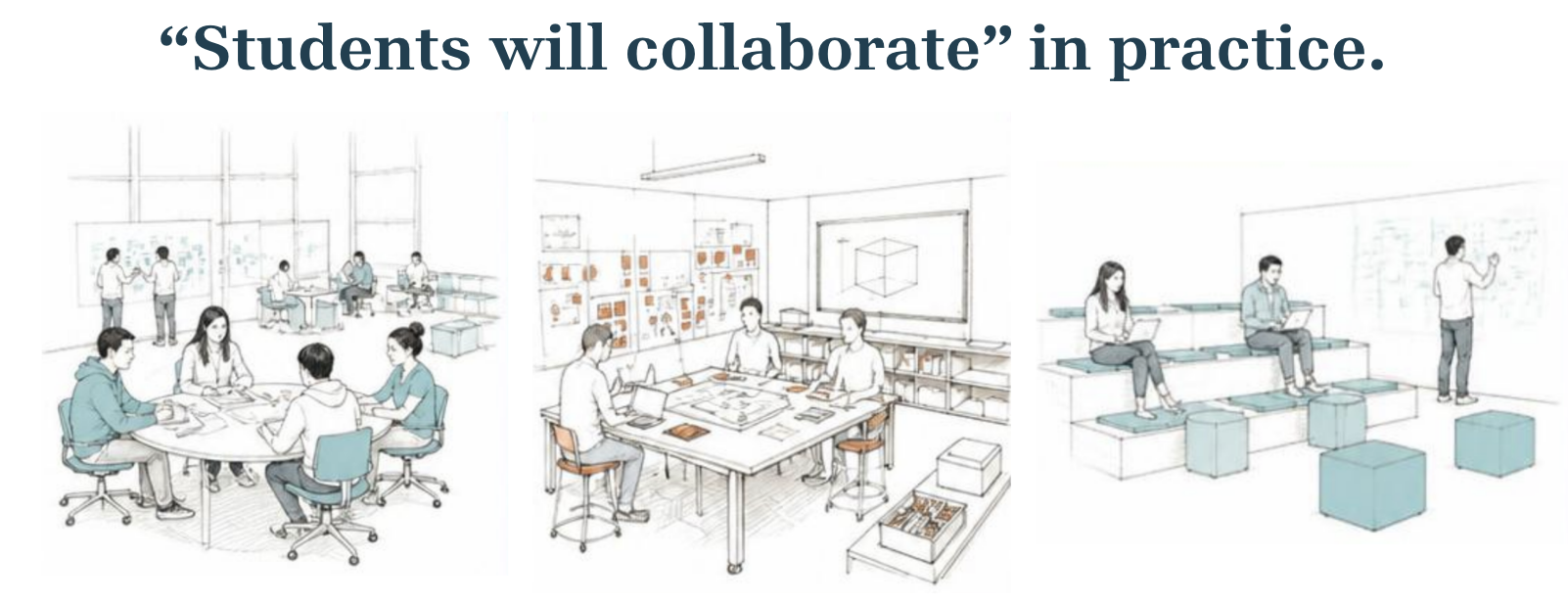
Experience can still be an abstraction:
Students will collaborate.
Faculty will mentor.
Programs will interact.
Students will learn through experience.
But what does any of that actually require?
Four students turning their chairs toward one another for ten minutes is collaboration. So is a project team working together for an entire semester. One might require movable chairs. The other might require a place where work can remain visible, materials can be stored, people can gather unpredictably, remote collaborators can join, and a project can develop over time.
Practices turn experiences into observable activity. They allow us to move from what we hope will happen to investigating what people actually do.
In higher education, those practices vary enormously. A historian, filmmaker, nurse, engineer, journalist, scientist, designer, and economist may all want students to collaborate—but what collaboration means within those disciplines can be completely different. We need to understand what people actually do when they say they collaborate. Faculty and students already possess enormous knowledge about these practices because they navigate them every day. They:
Move tables.
Carry equipment.
Improvise when the available technology doesn’t support the activity.
Borrow rooms.
Tape things to walls.
Find extension cords.
Send half the class into the hallway.
Search for somewhere quieter.
Stay after class because the conversation isn't finished.
Avoid an activity because setting it up takes too long.
Invent another way.
Those adaptations aren't simply inconveniences. They're clues—not necessarily to what space is missing, but to what people are trying to make possible. They show us where there is friction between what people are trying to accomplish and what the environment makes easy. They may also reveal possibilities people have already discovered for themselves.
Investigating practices means paying attention to those clues. Follow the equipment. Watch a class change modes. Map a project from beginning to end. Notice what gets moved, where people gather, what they carry, where they retreat, what they avoid, and what they have quietly redesigned for themselves.
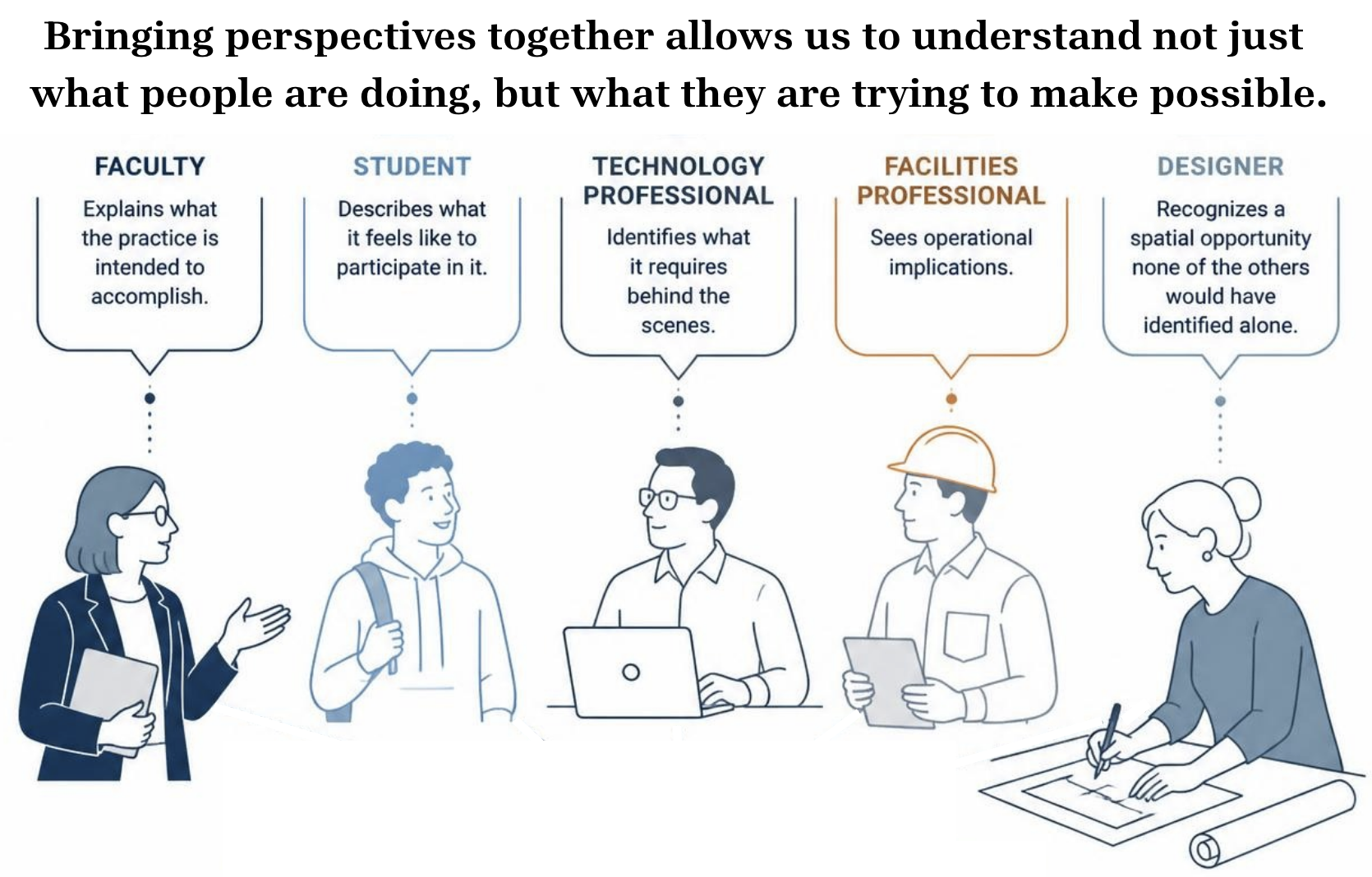
But observing a practice is only part of understanding it. No single perspective can tell us everything we need to know about what is happening—or why it matters. A faculty member can explain what the practice is intended to accomplish. A student can describe what it feels like to participate in it. A technology professional may identify what it requires behind the scenes. A facilities professional may see operational implications. And a designer may recognize a spatial opportunity none of the others would have identified alone. Bringing those perspectives together allows us to understand not just what people are doing, but what they are trying to make possible.
This isn't about prescribing how faculty should teach or students should learn—or assuming that today's practices define what will happen tomorrow. It's about understanding what people are trying to do now, what they might want to do in the future, and what currently gets in the way, so we can ask:
What conditions would make those practices easier, richer, or newly possible and create room for possibilities we haven't yet imagined?
This post is part of a six-part series asking “How do we know what a university capital project needs to accomplish?” Link to the other posts below.