How Do We Know What a University Capital Project Really Needs to Accomplish?
Part 1 of 6 in the series “How do we know what a university capital project really needs to accomplish?”
Link to other posts in the series at the bottom of the page.
Most higher education building projects begin with a need. Sometimes the need is basic: classrooms need to be modernized or a building's systems have reached the end of their useful life. Sometimes the need emerges from innovation: new technologies and equipment require new infrastructure, or interdisciplinary programs require departments that have long operated separately to come together. Other times the need grows from changing ideas about teaching and learning: faculty want to use more active approaches to learning, institutions want to better support diverse learners, programs want learning to become more visible, or campuses are looking for ways to foster a stronger sense of belonging. And sometimes the need grows directly from mission and vision: enrollment has changed and the campus needs different kinds of housing; a university is expanding beyond traditional degree programs; or new approaches to research, professional preparation, or community engagement require environments the campus was never designed to support.
Whatever the trigger, the process that follows is familiar: NEED → PLAN → DESIGN → BUILD
It's a logical process. Universities have to determine what to build, what it will contain, what it will cost, and how to deliver it. But how do we know we've defined the right need? “We need more classrooms” sounds like a need. So does “We need more collaboration space.” Or “This program needs a new building.” But each already contains a solution.
A request for more classrooms may actually be about supporting a wider range of teaching practices. A request for collaboration space may be about creating stronger connections among programs. A request for a new building may contain ambitions that go far beyond replacing the one an institution already has. Once a need is expressed as a spatial solution, the process naturally begins solving for it. Before you know it, faculty, students, and staff are occupying those new or renovated spaces.
But what if we solved the problem we identified and missed the opportunity behind it?
The classrooms may be modernized but still make it difficult to transition between different ways of teaching and learning. The interdisciplinary program may have a home but few opportunities for its disciplines to encounter one another. The student space may be beautiful and well used but do little to strengthen belonging. A professional learning environment may replicate the workplace without supporting the experimentation, feedback, and reflection that distinguish learning from working.
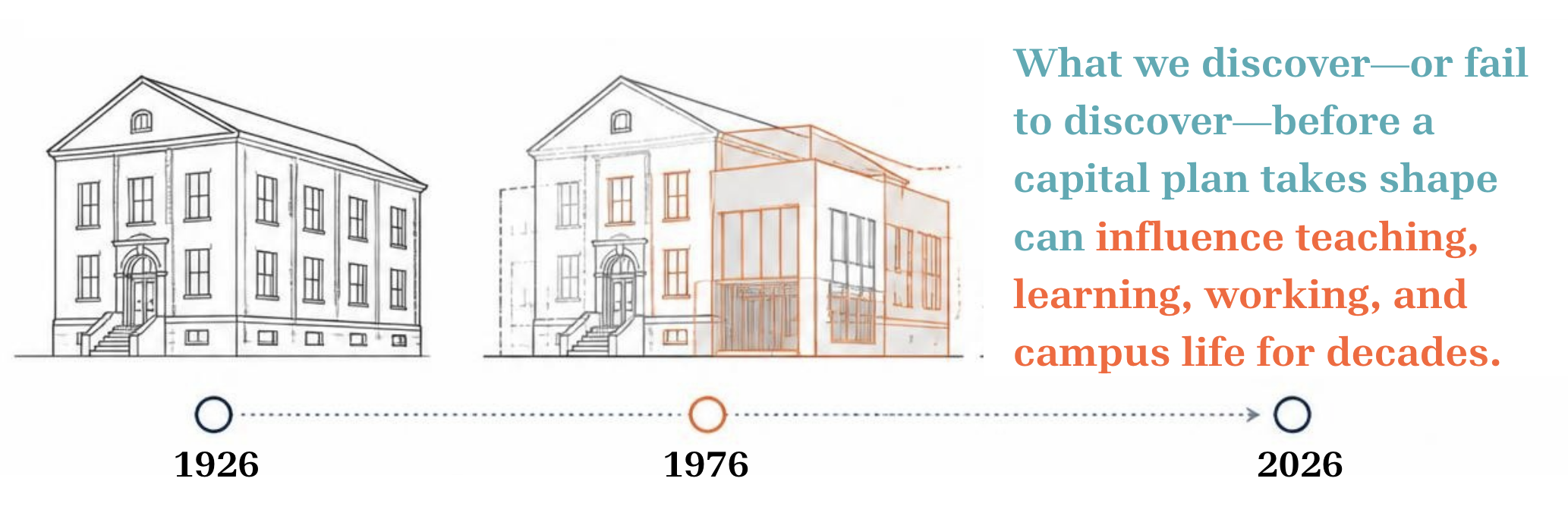
None of these spaces has necessarily failed. They may simply represent opportunities the project never knew to pursue. And those opportunities are difficult to recover later. Buildings endure. Major renovations may happen only once in a generation. What we discover—or fail to discover—before a capital plan takes shape can influence teaching, learning, working, and campus life for decades.
So before a need becomes a plan, there is an opportunity to ask something more: What does this investment really need to accomplish? We can investigate that question through four interrelated lenses that ask us to consider more specific questions:
PURPOSE: What is the institution trying to accomplish?
EXPERIENCES: What should people be able to experience?
PRACTICES: What practices need to be able to happen?
SPACE: What could the physical environment contribute?
We call the relationship among these questions alignment.
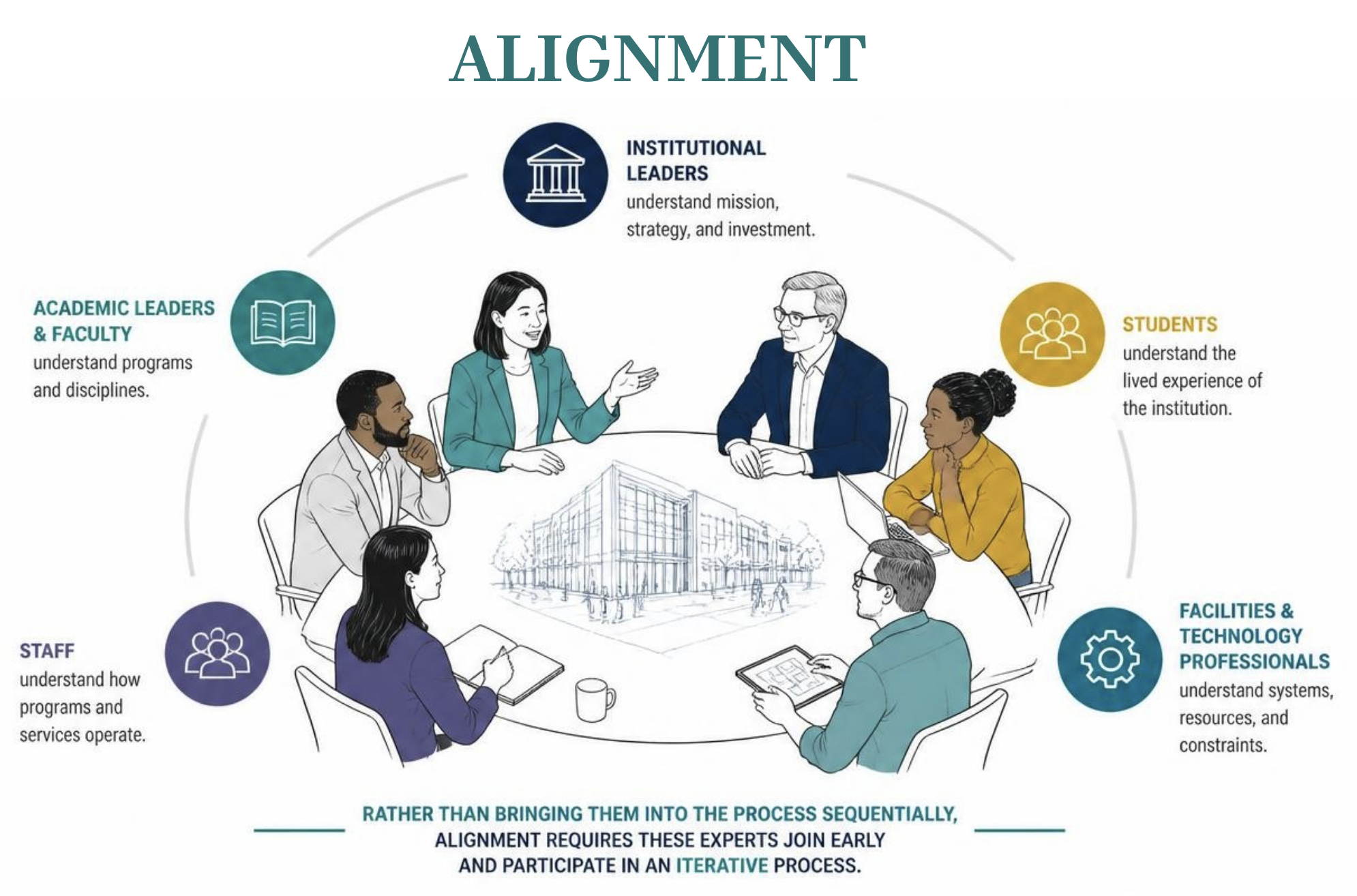
Alignment brings these questions—and the people who hold different kinds of expertise to answer them—into conversation before the need becomes fixed. Institutional leaders understand mission, strategy, and investment. Academic leaders and faculty understand programs and disciplines. Students understand the lived experience of the institution. Staff understand how programs and services operate. Facilities and technology professionals understand systems, resources, and constraints. Rather than bringing them into the process sequentially (e.g. academic leaders and faculty identify needs while architects and designers develop solutions), alignment requires these experts join early and participate in an iterative process.
Alignment doesn't replace the capital process. It provides a shared frame for defining the need, testing decisions as the project develops, and continuing to uncover what’s possible.
This post is part of a six-part series asking “How do we know what a university capital project needs to accomplish?” Link to the other posts below.