Align to Identify Experiences
Part 3 of 6 in the series “How do we know what a university capital project really needs to accomplish?”
Link to other posts in the series at the bottom of the page.
Purpose describes what the institution wants to accomplish. Experience asks what that ambition means for the people who will live it. If the purpose is interdisciplinary connection, what would it actually be like for a student to encounter another discipline? If the purpose is stronger community, where and how might someone experience belonging? If the purpose is closer connection with professional practice, what should a student be able to experience on campus that begins to approximate that world?
These are different questions from asking what rooms people need. Room names come with assumptions:
Classroom
Laboratory
Studio
Student lounge
Faculty office
Conference room
Corridor.
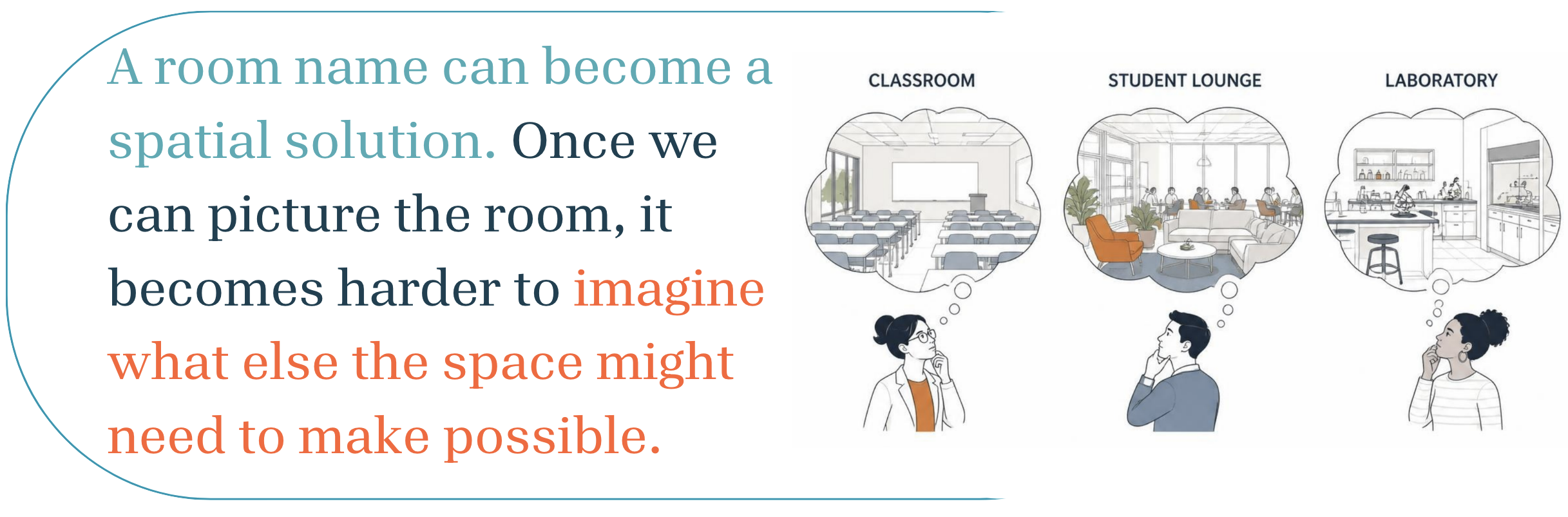
Say “classroom,” and many of us picture rows of seats facing the front of the room—or perhaps movable tables and chairs that can be rearranged for group work. Say “student lounge,” and we picture comfortable seating and places to gather. Say “laboratory,” and we picture specialized equipment and workstations. Those images aren't wrong. But they demonstrate how quickly a room name can become a spatial solution. Once we can picture the room, it becomes harder to imagine what else it might need to make possible.
What if we temporarily removed the room names? Instead, imagine what we want people to be able to experience in those spaces:
Work intensely with three other people.
Practice something until they get it right.
Encounter work from a discipline they know nothing about.
Present an unfinished idea and get feedback.
Have a difficult conversation in privacy.
Run into a professor and continue yesterday's conversation.
Find somewhere to be alone without leaving the academic community.
Watch someone with greater expertise do something they cannot yet do themselves.
Make something too large, loud, messy, delicate, expensive, or technically demanding to make anywhere else.
Now we're not talking about rooms. We're talking about experiences. And those experiences can change how we see the campus.
A corridor might matter because students can see work happening as they pass. A stair landing might matter because conversations continue there. A specialized environment might matter not because a program “needs a lab,” but because it allows students to experience something they otherwise could only read about or observe. Some experiences may depend upon specialized environments. Others may depend upon proximity, visibility, privacy, choice, or simply having somewhere to continue what began somewhere else.
Experience moves us from asking what should be here to asking what should happen because people are here.
This post is part of a six-part series asking “How do we know what a university capital project needs to accomplish?” Link to the other posts below.