Investigate the “Fix”
Part 4 of 5 - “How can we uncover what’s possible in an existing school?”
Links to other posts in the series provided below.
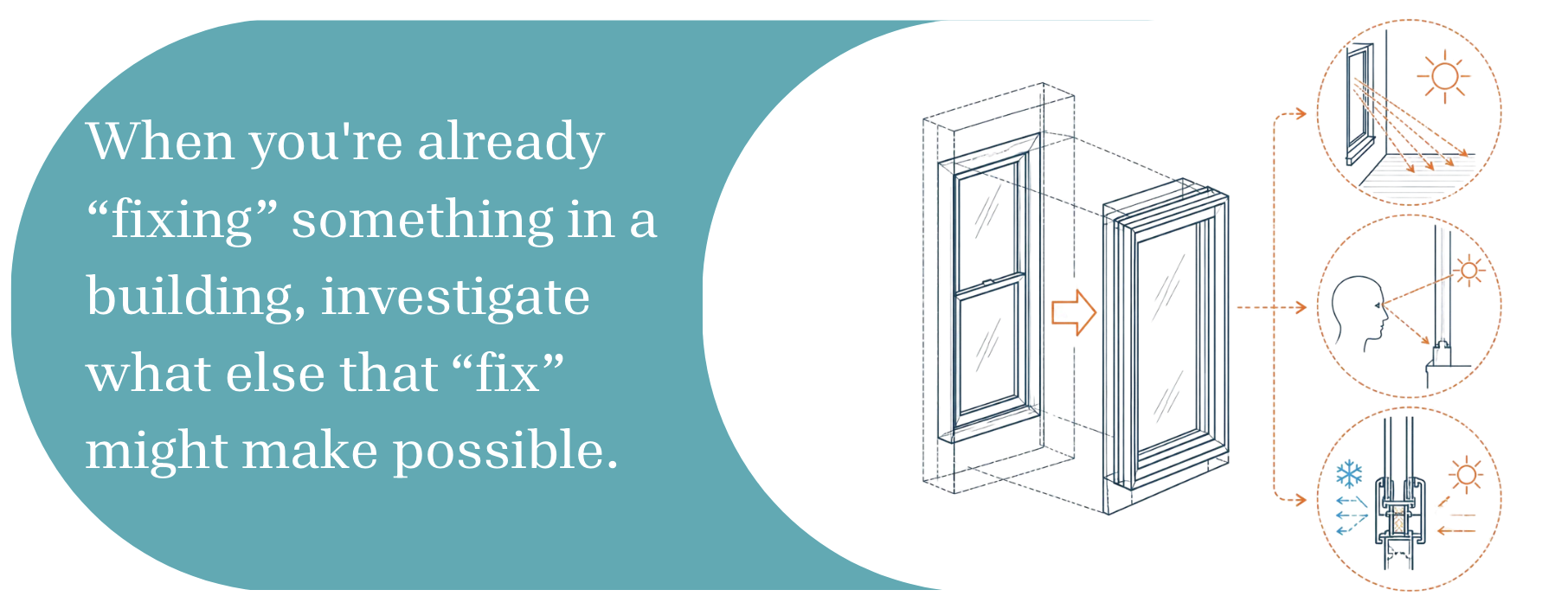
A roof needs replacing. An HVAC system is reaching the end of its useful life. Windows are failing. These may sound like straightforward infrastructure problems, but identifying what needs attention doesn't necessarily tell us the best way to address it.
Take the roof. “We need a new roof” can quickly become a project definition. But there may be multiple ways to respond: full replacement, recovery, different roofing systems, different approaches to insulation and drainage. Each comes with implications for cost, longevity, structure, energy performance, adjacent building systems, and future work. Before choosing the fix, investigation helps a district understand those relationships and make a more informed decision about what it is actually investing in.
Because the roof is never just the roof.
The same is true throughout an existing building. Infrastructure systems overlap with one another and with the spaces they support. A decision about one component can create constraints—or opportunities—somewhere else. Investigation asks us to understand those connections before defining the solution.
And sometimes a major infrastructure project creates a rare moment when parts of a school that are normally fixed become changeable. Ceilings come down. Walls open. Windows come out. The district is already investing money and accepting disruption—and those parts of the building may not be touched again for decades. The conventional goal is to fix the problem and restore what was there. Investigation asks what that disruption might make possible. That makes it worth asking not only “What's the right fix?” but also “What else should we consider while we're here?”
If ceilings are already coming down, could acoustics or lighting improve before they go back up? If windows are being replaced, could the project also improve daylight, glare, or thermal comfort? If mechanical systems are changing, could better control over temperature, noise, and air movement create environments that work better for more students?
Sometimes the answer will be yes. Sometimes investigation will reveal that expanding the scope doesn't make sense. That is valuable information too. The goal isn't to turn every repair into a larger project. It's to understand the choices, relationships, and consequences well enough to make the right investment at the right time.
And sometimes one intervention unlocks another: opening a wall makes it possible to connect two spaces; relocating equipment frees space for another use; coordinating improvements avoids reopening the same ceiling five years later. Looking across systems and planned projects can reveal opportunities to coordinate work, avoid duplication, anticipate future needs, or make an improvement more economical while the building is already disrupted.
The “fix” becomes an opening.
Instead of asking “How do we fix this problem?,” ask “What possibilities does this fix give us the opportunity to uncover?”
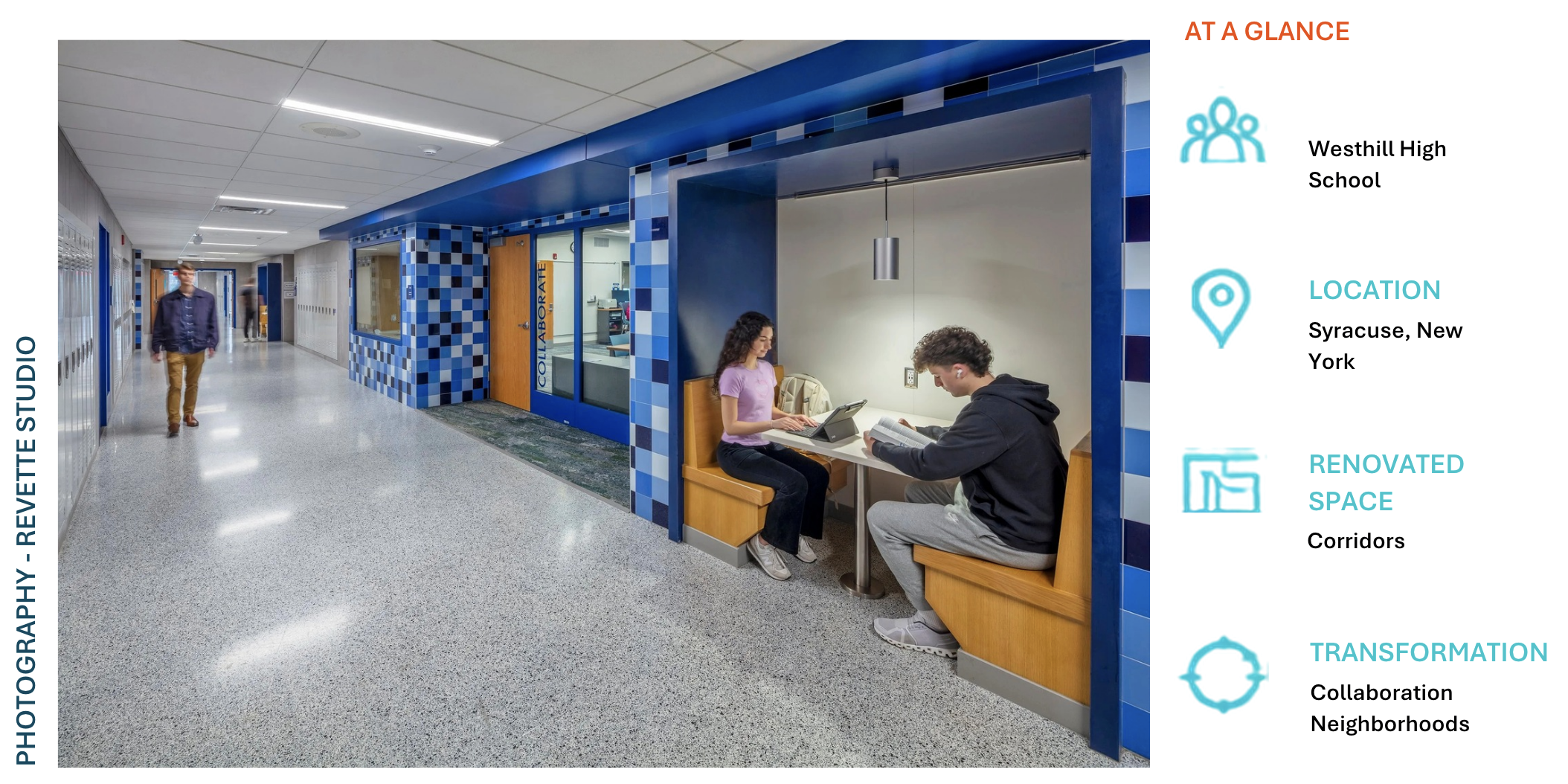
Westhill High School's academic wing hadn't been renovated since the school was built in 1962. The roof, exterior envelope, windows, and HVAC needed significant work. The district was already going to make a substantial investment in the wing—and disrupt it in ways that might not happen again for decades.
Investigation began with that necessary work but didn't end there. Because multiple systems and parts of the building were already being addressed, the district had an opportunity to consider the academic wing as a whole rather than as a collection of individual fixes. That opened a larger question: How should this part of the school support teaching and learning for the next 50 years?
Conversations with educators revealed a need for learning to extend beyond the classroom. Students needed places to work together in smaller groups, collaborate more independently, and continue conversations and investigations outside scheduled class time. But the existing 1962 plan offered an arrow-straight, double-loaded corridor designed primarily to move students between classrooms.
So instead of simply putting the academic wing back together as it had been, the corridor itself was reconsidered. Its straight path was jogged to create wider collaboration neighborhoods along the way—turning circulation space into learning space. Visual connections to classrooms and small-group rooms allow students to work more independently while remaining connected to teachers, and make the learning happening throughout the academic wing more visible.
The necessary “fixes” didn't dictate the shape of the new corridor. They created the moment to question whether the old shape still served the school. In this case, investigating necessary infrastructure work uncovered an opportunity for a larger transformation. In another project, the result might simply be a better roofing strategy, a more coordinated sequence of improvements, or the decision not to expand the scope at all.
The value is in knowing the difference.
Don’t let the fix define the project. Investigate what else it could make possible.
This post is part of a four-part series asking “How can we uncover what’s possible in an existing school?” Link to the other posts below.