Investigate the Workarounds
Part 2 of 5 - “How can we uncover what’s possible in an existing school?”
Links to other posts in the series provided below.
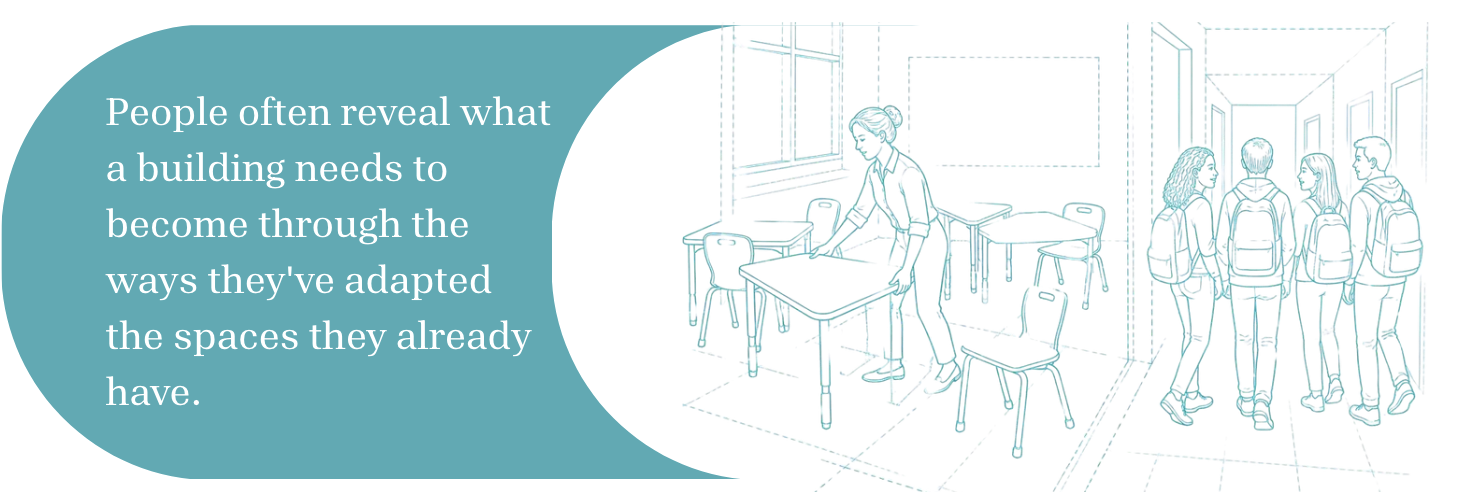
Educators don't wait 50 years for the next capital project to change how they teach. They use the spaces available to create the experiences their students need:
A teacher pulls a small group into the corridor.
Furniture gets rearranged every morning.
Equipment travels between classrooms.
Students consistently gather in a particular corner.
A space designed for one purpose gets pressed into service for another.
Over time, those workarounds become invisible. They're simply how the school operates. During a renovation, they become evidence.
Investigating them means asking why. Why this hallway? Why does the furniture move every day? What is the teacher trying to accomplish by moving students from one setting to another? Why do students choose this particular spot? What does that storage room provide that the classroom doesn't? What are educators and students able to do in one place that they can't do somewhere else? The point isn't simply to eliminate the workaround. It's to understand the purpose behind it. What experience are teachers and students trying to create with the spaces available to them?
In other words, the workaround becomes the clue
Case Study: From Central Space to Center of Learning
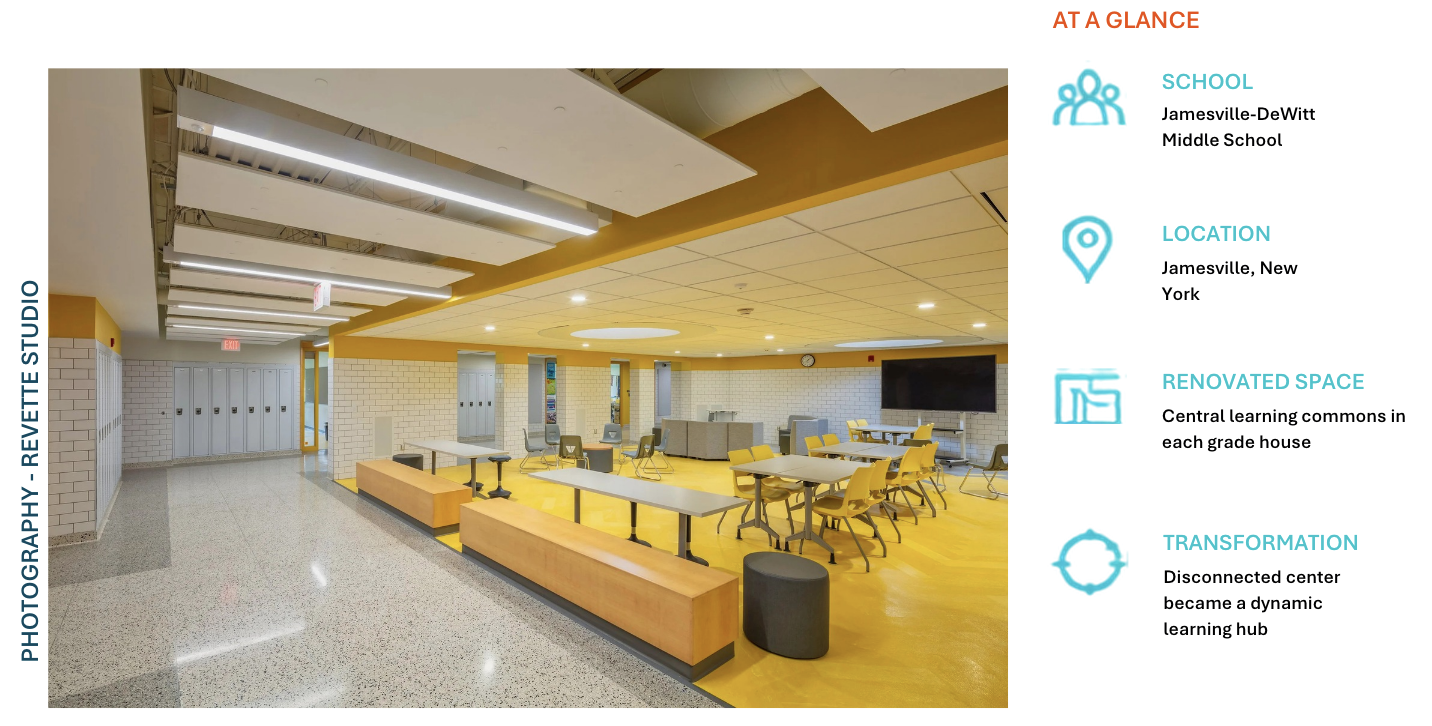
At Jamesville-DeWitt Middle School, each grade is organized into a “house,” with classrooms surrounding a central space. Yet over time, those centers had become largely disconnected from the learning happening around them. They were at the center of each house without really being the center of learning. The opportunity was to think about those classrooms, corridors, and central spaces not as separate parts of the building, but as a connected learning environment.
We went searching for clues about what those spaces wanted to become by investigating how teachers were working around—rather than in or through—them. We look at the different ways educators needed that environment to support learning. At times, students might learn together as a whole group; at others, they might work in small groups or independently. Different activities might emphasize kinesthetic, visual, or auditory experiences. Rather than expecting teachers to continually adapt whatever space was available, the question became: How could we intentionally design variety and choice into the learning environment itself?
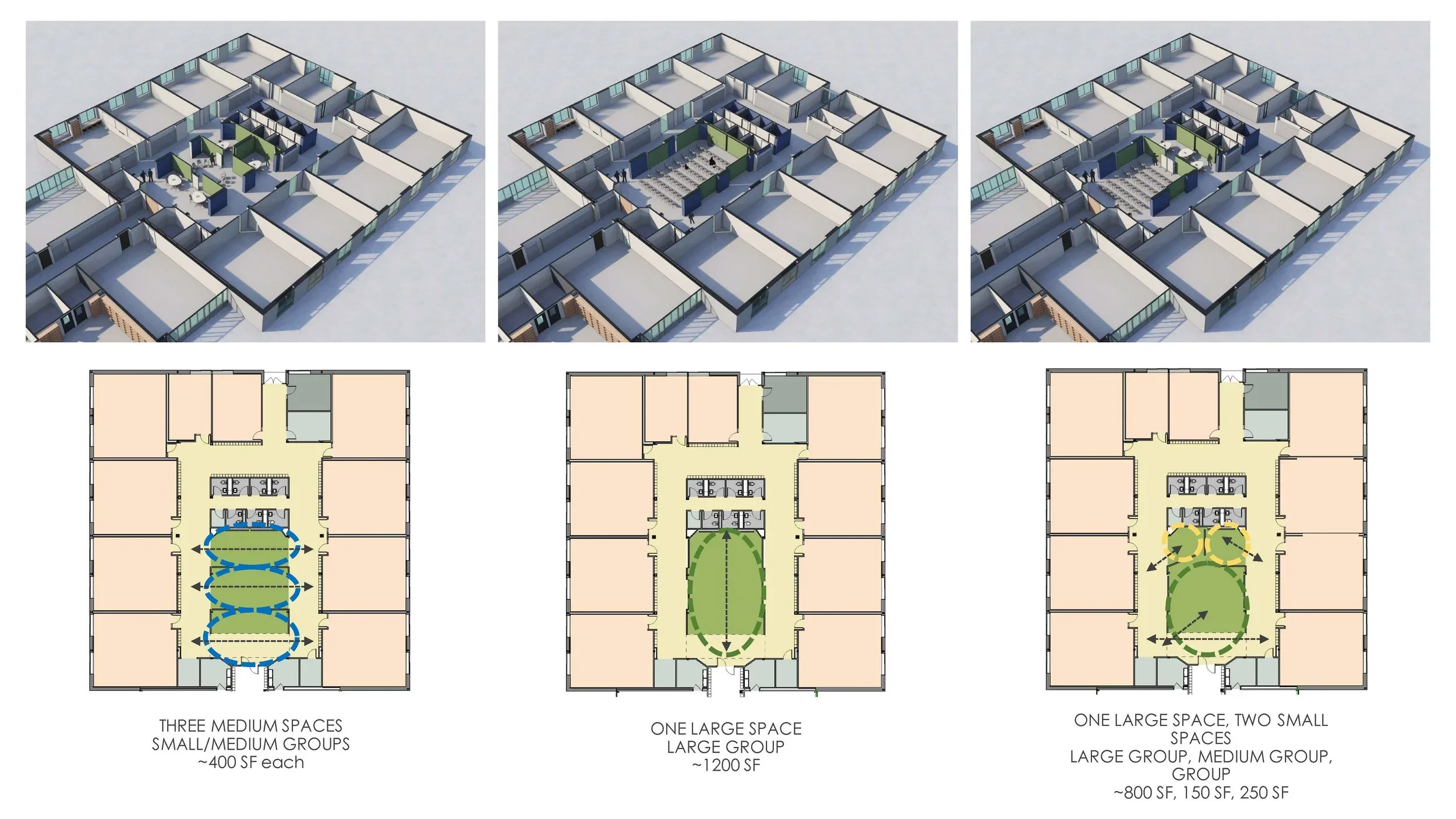
That question became a driving design idea for the project. The classrooms, corridors, and central collaboration zones could work together to give educators and students access to different scales, settings, and modes of learning. After renovation, the centers could accommodate more than 70 students for interdisciplinary projects, team teaching, demonstrations, or exhibitions, then divide with mobile partitions into smaller settings for collaboration, critique, targeted instruction, or focused work. The surrounding classrooms and corridors extended that range of choices, allowing educators and students to move among different learning environments while remaining connected to the larger house.
The center space also created another opportunity: making learning visible. Writable and display surfaces now allow ideas, works-in-progress, and student projects to move beyond individual classrooms and into the shared environment. Students and teachers can see what others in the house are exploring, creating opportunities for observation, conversation, critique, and connections across classes.
The investigation uncovered a possibility hiding in plain sight.
Rather than asking teachers to make the spaces serve every kind of learning, the house itself could be purposefully designed to offer variety and choice—a connected environment where the scale, mode, and visibility of learning could change as the learning itself changes.
This post is part of a five-part series asking “How can we uncover what’s possible in an existing school?” Link to the other posts below.