How can we uncover what’s possible in an existing school?
Part 1 of 5 - “How can we uncover what’s possible in an existing school?”
Links to other posts in the series provided below.
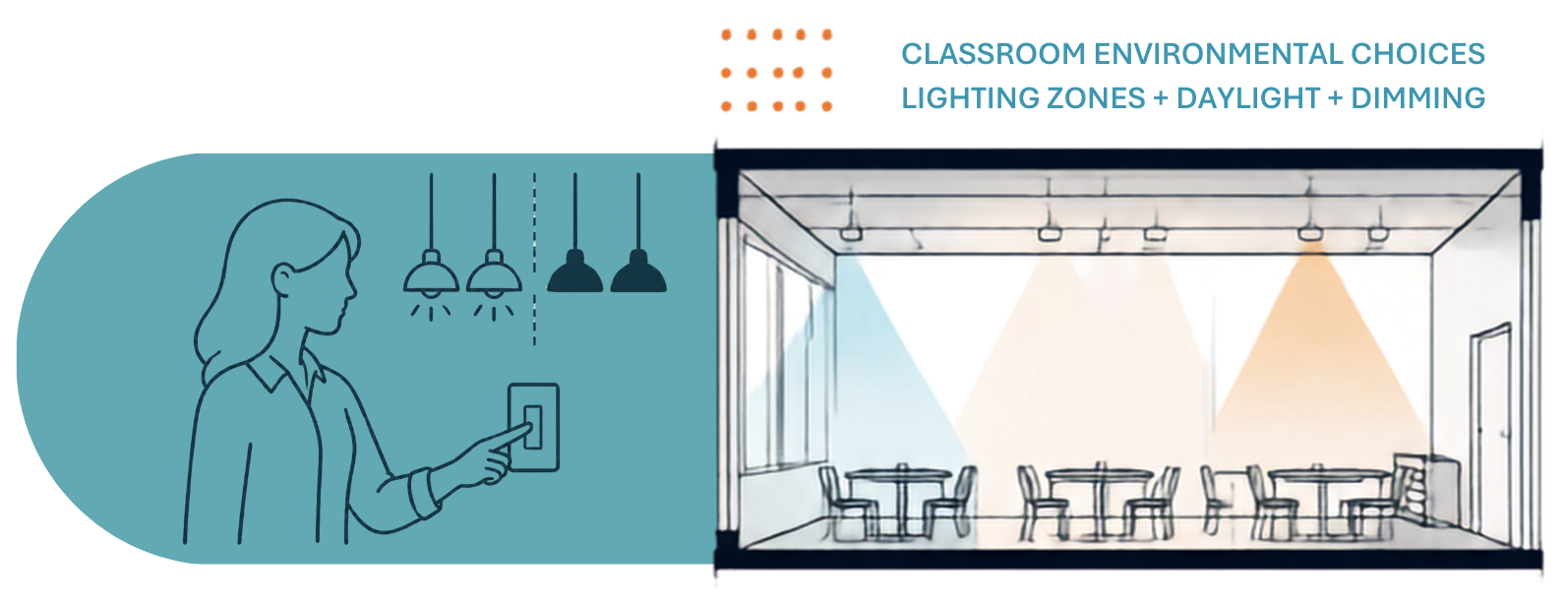
Every morning, a teacher walks into her classroom and turns off half the lights. She has learned that the full bank of aging fluorescent fixtures is more light than she needs for most activities. During a presentation, she turns off another row. When students begin hands-on work, some lights come back on. On bright days, daylight does most of the work.
Meanwhile, the district's facilities plan has identified those same fixtures as an infrastructure problem. They're aging, inefficient, and due for replacement.
On paper, the solution seems obvious: replace the old lights with new ones.
But walk through the classroom door and look at what actually happens there. The teacher's daily routine is a clue. She isn't simply turning lights on and off. She is continually adjusting the environment to support different activities, different students, and different experiences within the same space.
What if the lighting project began there?
Instead of replacing one uniform lighting system with a newer uniform lighting system, could the renovation provide zones, dimming, daylight-responsive controls, and different lighting conditions within the classroom? Could educators shift the environment for discussion, presentation, hands-on work, or focused individual activity? Could students who are more sensitive to visual stimulation have choices without needing to leave the learning community?
The lights still need to be replaced. But investigating why the teacher keeps turning them off can tell us something about what should replace them.
The lighting example is hypothetical. But the opportunity it illustrates is very real—and particularly important in buildings that may undergo a major renovation only once every 40 or 50 years. By the time that opportunity arrives, a district usually knows a lot about what's wrong. Facilities and master planning have identified aging systems, outdated classrooms, changing program needs, accessibility issues, underused spaces, and demands for additional capacity.
The danger isn't that we don't know enough about the building. It's that knowing what we need can make us think we already know the solution. “We need more capacity” becomes “we need an addition.” “This office suite is underused” becomes “we need to assign it a new use.” “The lighting is old and inefficient” becomes “we need to replace the lighting.” Somewhere between identifying a need and defining a project, a need can quietly become a solution.
Any of those solutions may ultimately be right. But if we move too quickly from need to answer, we risk closing off possibilities before we've had the opportunity to discover them.
Somewhere between identifying a need and defining a project, a need can quietly become a solution.
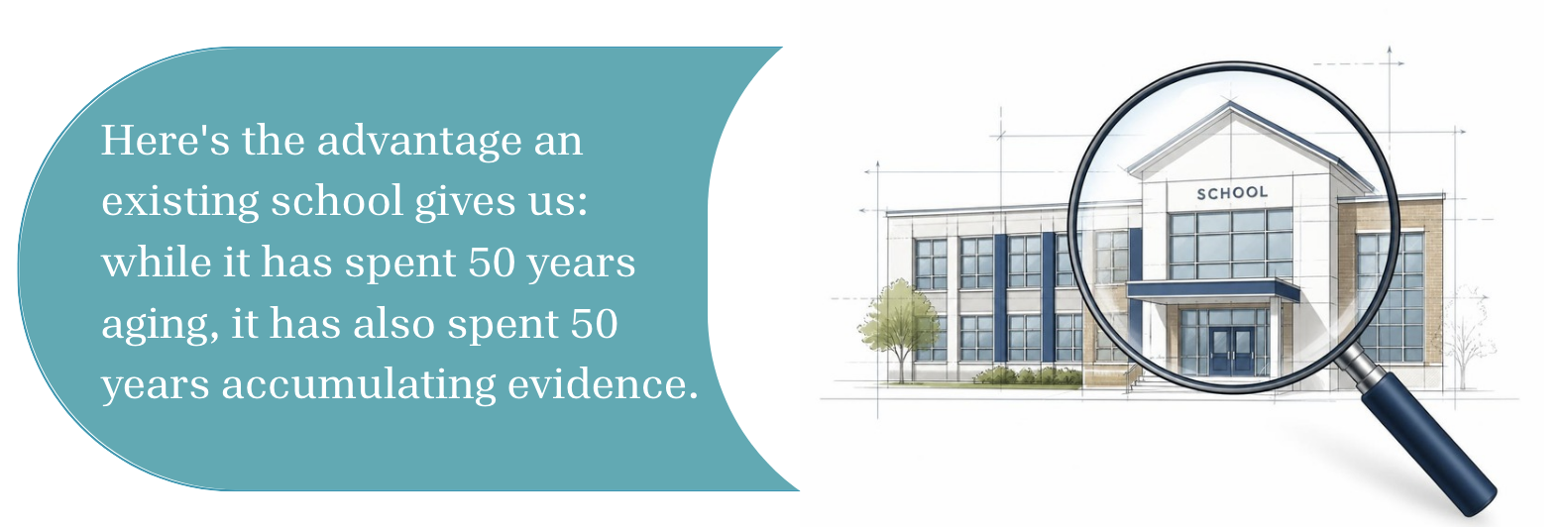
And here's the advantage an existing school gives us: while it has spent 50 years aging, it has also spent 50 years accumulating evidence. The workarounds teachers and students have developed are evidence of needs the building isn't currently meeting—and of what they're already trying to make possible. Rooms that are underused or no longer serve their original purpose are evidence of capacity that might be reimagined to meet needs elsewhere. The ways students gather, retreat, collaborate, or appropriate spaces are evidence of the kinds of environments they seek but may not have been intentionally provided. What is displayed, celebrated, or made visible can tell us something about what the school values—and whether the physical environment reflects the community it serves. And necessary infrastructure work is evidence of where the building is already going to change—and where that intervention might unlock opportunities to do more.
Investigating for such evidence can have very practical consequences: square footage a district doesn't need to build, spaces that support a greater range of learning experiences, improvements that can be coordinated rather than duplicated, and necessary infrastructure investments that accomplish more than simply replacing what was there. It can also help a school make more intentional choices about the experience it creates and what its physical environment communicates about the community within it.
In working with our clients, we have found three forms of investigation that are easy to carry out and can yield high value both in terms of costs and learning: investigate the workarounds; investigate what’s already there; and investigate the fix.
This post is part of a five-part series asking “How can we uncover what’s possible in an existing school?” Link to the other posts below.