Investigation Changes the Value of Renovation
Part 5 of 5 - “How can we uncover what’s possible in an existing school?”
Links to other posts in the series provided below.
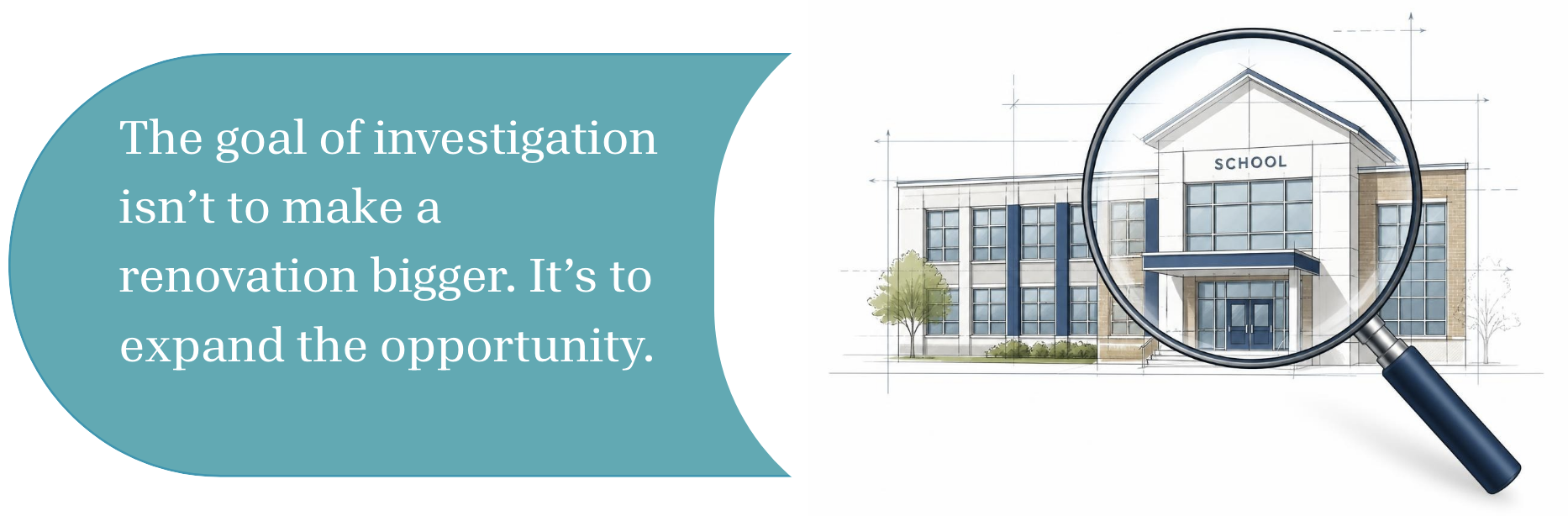
A facilities plan helps a district understand what it has, what it needs, and where to invest. Investigation asks something different: What haven't we discovered yet?
That question matters because the possibilities we've been exploring aren't necessarily visible on a list of identified needs. They emerge when we investigate how educators and students have adapted their spaces, reconsider the capacity already within the building, and ask what else necessary work might make possible.
Some renovations are essential to keeping a school operational. Roofs need to keep water out. Boilers need to heat the building. Lighting needs to work. Aging systems need to be replaced. That work matters enormously, even when much of its value is largely invisible once the project is complete.
But a school building does more than operate. People learn, teach, collaborate, concentrate, gather, create, struggle, celebrate, and build community there. Renovation creates an opportunity to consider both: what the building needs in order to perform and what the people inside it need in order to thrive.
The greatest value can emerge when those two kinds of thinking come together. A necessary infrastructure investment might create an opportunity to improve the experience of a classroom. Existing square footage might be reorganized to support a greater range of learning. A space people pass through every day might become a place where they connect. The return on the investment isn't only fiscal. It can also be realized in the everyday experience, well-being, and success of the school community.
That's why the goal of investigation isn't to make a renovation bigger. It's to expand the opportunity.
A major renovation may come only once in 40 or 50 years. Of course we need to fix what isn't working. But if we move directly from problems to solutions, we risk rebuilding our assumptions along with the building. Investigation creates space between the need and the solution—a space where districts, educators, students, communities, and designers can look at the evidence together, challenge what they think they already know, and imagine what the investment could accomplish.
Investigation a collaborative act. The people who inhabit a school bring knowledge of what happens there every day. District leaders bring an understanding of their priorities, resources, and future needs. Designers bring another way of seeing the building—recognizing relationships, constraints, and possibilities that may not be immediately visible. The opportunity emerges from bringing those perspectives together.
And that’s what we value at Ashley McGraw.
Collaborating with our clients allows us to uncover what’s possible in an existing building and for the people who make it a school.
This post is part of a five-part series asking “How can we uncover what’s possible in an existing school?” Link to the other posts below.